🌐 ENGLISH VERSION
This site was written in French, and this is its English translation. Small differences or imperfections are possible: the French version remains the reference. The reader comments area and the search results may still appear in French.
Your opinion matters: tell me what you would change or add. Use the contact form on the home page or leave a comment on the Blog (English and French both welcome).
THE SWAMP
“An artificial-looking anomaly in the heart of Oak Island.”
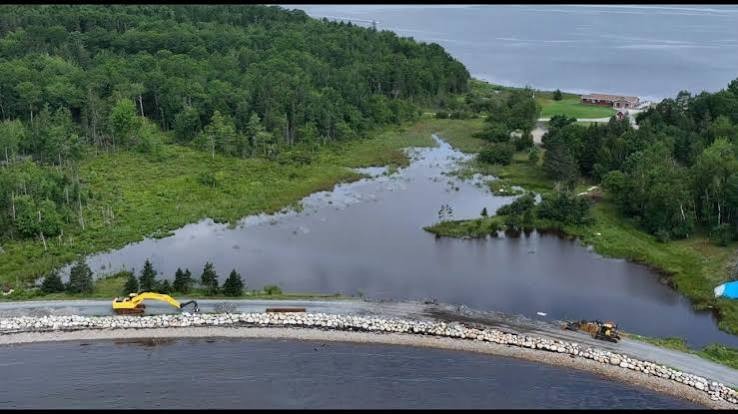
THE SWAMP ANOMALY: A SUNKEN SHIP?
The Swamp is probably the strangest area of Oak Island. Its almost perfectly triangular shape has led some researchers to wonder whether it is really natural. This is where Fred Nolan devoted decades of research, noting there, according to his own observations, wooden stakes he judged to be ancient and structures he interpreted as naval.
Thanks to the sonic and seismic coring carried out by the Lagina brothers, a significant anomaly was detected in the mud. What it is exactly, nobody knows: some read in it the shape of the hull of a large ship (a Spanish ship or a warship galleon), but this is only an interpretation, and no ship has been recovered to date. In this hypothesis, the ship would have been deliberately brought into the swamp, unloaded, then scuttled in the 17th century, and the area would then have been flooded to create an artificial swamp, the shroud of a possible treasure. This is a theory, not a fact. There is indeed an anomaly in the ground, but what is it? Only an excavation could tell.
Under this mud, the team also uncovered a monumental stone-paved road of European origin, built to support the transport of extremely heavy industrial loads, as well as a mysterious circular depression called “The Eye of the Swamp”.
THE ARTEFACTS & THE FLUORESCEIN TEST
The ground of this area has proved to be a gold mine of clues. It is here that the famous Spanish maravedi was dug up, a 17th-century copper coin (some estimates suggest 1652, but the exact date is not confirmed). The swamp has also yielded hand-forged iron ship nails, very old pieces of naval rigging and fragments of pottery brought up by Billy Gerhardt's excavator.
But one of the most memorable scientific operations on the island remains the great fluorescein dye test. In order to map the underground connections and check whether the swamp water communicated with the flooding networks, the engineers injected massive quantities of this non-toxic dye, a brilliant fluorescent green, at the bottom of the Money Pit shafts. Within a few hours, before the astonished eyes of the researchers, the waves of the Atlantic Ocean turned fluorescent green all around Smith's Cove and the swamp shore, which shows that there are water passages between the swamp and the ocean; it remains to be seen whether they are natural or artificial [💡].
THE SUSPENSION OF THE DIGS: THE MI'KMAQ ARTEFACTS AFFAIR
At the very beginning of the adventure, internet critics and skeptics took Rick and Marty Lagina for simple amateurs stirring up mud for television. Then, during the archaeological work on the stone road, a fragment of pottery of Native American origin, linked to the indigenous Mi'kmaq people, was discovered.
According to reports, the Nova Scotia Department of Communities, Culture and Heritage and the Acadia First Nation council ordered the suspension of archaeological activities on a large part of the island, until an independent survey could be carried out. The protection of indigenous heritage is a legitimate reason. But the effect was immediate: with no way to dig, the young archaeologist Miriam Amirault, who spent her days delicately cleaning the stones of the road, and other academics left the production.
The Lagina brothers say the rules are too complex to be followed. This episode partly answers those who accuse them of dragging out the show: part of the delays really does come from administrative decisions. Why this halt, and what should be done instead? I raise the question in “My personal opinion” (page “Personal View”, in French).
A HYPOTHESIS IN PICTURE: THE ISLAND CUT IN TWO?
What we know. An anomaly was detected in the swamp mud, which some read as the hull of a large ship, although no ship has been recovered. A dye test showed that the swamp water communicates with the ocean. The nature, age and origin of these passages remain to be established.
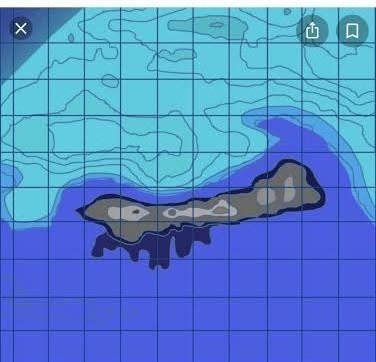
What this drawing shows. An imagined scenario: what if the swamp area, at lots 12 and 32, had been an arm of the sea cutting the island in two, with a ship brought all the way there? The drawing shows this idea; it does not prove it.
Its limits. No source shows that the island was ever cut in two. The channel and the ship are drawn for illustration only, with no scale or exact position. This is a hypothesis, not a fact.
Last review: October 2026 · Unofficial site · Legal notice · The Blog