🌐 ENGLISH VERSION
This site was written in French, and this is its English translation. Small differences or imperfections are possible: the French version remains the reference. The reader comments area and the search results may still appear in French.
Your opinion matters: tell me what you would change or add. Use the contact form on the home page or leave a comment on the Blog (English and French both welcome).
BEHIND THE SCENES & MY PERSONAL VIEW
“In the face of Internet criticism: my truth about the human adventure of Oak Island.”
MY STORY: WHY THIS SITE EXISTS
Hello everyone,
Let me introduce myself: my name is Jean-Philippe. I am an IT specialist, a mechanic, a building electrician, a former industrial electrician, a consumer electronics technician and an embedded electronics technician. Life has not given me any gifts, but by opening my company, I discovered serenity.
Since 2024, a health problem made me lose my company, which I had opened twenty years earlier. As time went by, I was sinking, when I came across Oak Island. My friends and family laughed: to me, this island was unknown, just like the research carried out there. But as I love everything to do with treasure discoveries, archaeology and so on, I got hooked on the show. I started to look a little to find out whether it was true or false, then I started to retrace the life of the show.
Searching the Internet, I saw criticism of every kind, and I told myself: why not make a site about this community of researchers? And there it is: after a year and a half of work, I was able to fulfil my wish.
Why so long? Because I do it with one hand and with pain 24 hours a day. But the result is here. So yes, I will be criticised, but I wanted to go all the way.
Why “Oak Island and the Lost Treasure”? On the Internet, I found “Oak Island, the treasure”, but nowhere the word “lost”. Yet people have been searching for it for more than 220 years, and no one has found it: for me, it really is a lost treasure.
Jean-Philippe
1. THE MEANING OF THE QUEST: A BOYHOOD DREAM COME TRUE
Surfing the Internet, you find an industrial quantity of snap judgements, mockery and easy criticism. Many sceptics claim on the forums that there is nothing on this island, or that the TV show deliberately drags out the digs for money by showing only old nails and bits of wood. But for me, the truth lies elsewhere, and it is much bigger. Those who criticise completely miss the real magic of this adventure: the story of two 11-year-old boys who had an idea in their heads and who spent their whole lives giving everything to make it come true.
It all began in January 1965 with that legendary article in the famous magazine Reader's Digest of January 1965 which young Rick Lagina read in his school library. That day, a brotherly promise was born. Today, seeing Rick, this former Michigan mail carrier guided by his faith and his respect, take his brother Marty and his loved ones along in this crazy challenge is a magnificent lesson in perseverance and loyalty. That is the real truth of Oak Island. They did not just stir up mud, they made their childhood come true.

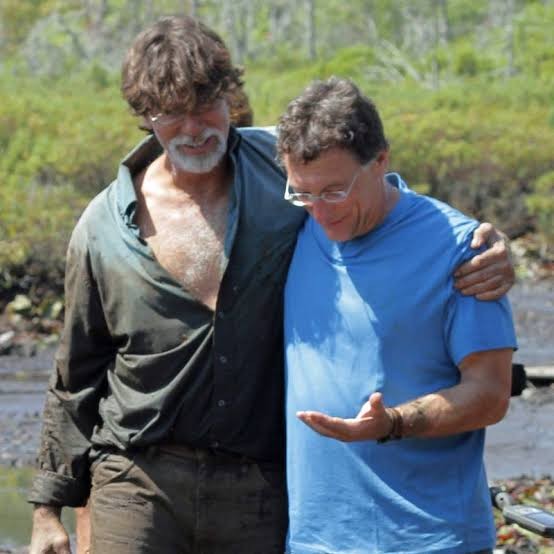
“When you want something specific, you have to know what you're talking about: the Who, the Why, the How, as Rick would so well put it.”
2. THE REALITY OF THE BLOCKS: WHEN HISTORY BECOMES TOO REAL
There is another argument the critics forget: at the beginning, nobody believed in them, and the authorities let the brothers work in general indifference. Then a fragment of pottery linked to the indigenous Mi'kmaq people was discovered, and archaeological activities were suspended over a large part of the island.
The decision came from the Nova Scotia Department of Communities, Culture and Heritage and the council of Acadia First Nation, pending an independent survey. Collaborators such as the archaeologist Miriam Amirault then left the production. This shows that the Lagina brothers did not slow the worksite by choice for the sake of television: part of the delays comes from administrative decisions. My site is here to restore that part of the truth, with heart and facts.
3. THE SCEPTICS' ARGUMENTS, AND WHAT THEY DO NOT EXPLAIN
An honest site must also give a voice to those who doubt. Here are their main arguments, presented as they put them, followed by what remains hard to explain to this day.
A natural sinkhole? The region rests on limestone and gypsum (anhydrite), rocks that readily form cavities. The geologist Steven Aitken believes the Money Pit could be a collapse of this kind, and a natural subsidence was reported near the shaft in 1878. On this reading, a simple tunnel connected to the sea would be enough to explain the flooding of the shafts, with no human engineering.
Other natural cavities in the region. In 1949, workers digging a well on the shore of Mahone Bay, about five miles (8 km) south of Oak Island, broke into a natural void; Wikipedia and thecurseofoakisland.com both report it. According to the latter, sewer works in 1875, about 3,000 feet (900 m) north of the island, also opened a natural cavern 52 feet (about 16 m) deep. These cases prove nothing about the Money Pit itself: they only show that this kind of cavity exists in the region.
Stories that get embellished. The earliest press articles mention neither the pulley hanging from the branch nor the log platforms: these details appear in later accounts, ever more spectacular.
The engraved stone. It was never photographed and is said to have disappeared around 1919. Many researchers consider it doubtful, for lack of any official record.
The symbols. The sceptical investigator Joe Nickell sees in them the possible trace of Masonic rituals, rather than that of a treasure.
What this thesis explains poorly. “Coconut” fibres, analysed in 1970 (three samples out of four) and dated to around the year 1200 according to one source (other sources give dates between 1100 and 1400), that is before the arrival of the Europeans: even the sceptics acknowledge that this point remains hard to explain. For their part, the objects presented as medieval by the show's team remain to be independently validated (see the page “The Discoveries”).
In the end: the sceptics have not proved that there is nothing, and the researchers have not proved that there is a treasure. To date, no treasure has been found.
Sources: Brian Dunning (Skeptoid), ExplorersWeb.
4. THOSE WE NEVER SEE ON SCREEN
Yes, nobody forces them. But those who stay in the shadows (spouses, children, loved ones of those who dig) help too, in their own way: by supporting a quest that has lasted for years, they are part of it. No camera, no glory, and yet, without this quiet support, would the adventure last as long? We often talk about the treasure being sought; we talk more rarely about what each person leaves behind in it. And what if, deep down, the real treasure was family?
5. MY PERSONAL OPINION: THE WHO, THE WHY, THE HOW (ANSWER TO THE CRITICS)
Let's take up Rick's rigorous method in the face of the sceptics. Yes, the team finds forge nails and pieces of hewn wood, but, in my opinion, they are not mere rubbish: they are time capsules, which science allows us to date. The HOW (Dating): a piece of wood allows scientific Carbon-14 dating. An iron nail allows the blacksmith Carmen Legge to analyse the head and the forging method. When science states that this wood was cut in 1650 or that this iron comes from a colonial chest or a Spanish galleon, it is no longer a supposition, it is a historical fact engraved in the material.
The WHO (The Renowned Experts): if Oak Island were a staged production or a mere hoax for television, would respected university scientists such as Dr Christa Brosseau, Dr Ian Spooner or Dr Xiang Yang put their worldwide reputation and that of their university on the line to analyse fake objects? Absolutely not. The seriousness of these researchers validates the reality of the discoveries. The WHY: why would men have built a U-shaped monument, a massive unloading jetty at Smith's Cove and complex artificial flood channels centuries before 1795 if it were not to hide and protect something of inestimable value? Nobody moves thousands of tonnes of earth in the middle of the ocean for a joke.
My question. Why are people allowed to search for years, and then everything is stopped as soon as an indigenous object is found? The official answer is the protection of heritage, and it is legitimate. But I keep asking myself the question: what other outcome could there have been?
What I would propose. So far, from what the show displays, the Lagina brothers have respected everything that was precious. I think they could be allowed to continue without putting obstacles in their way, with the lead archaeologist at their side: when something is found, it is left in place, the person concerned is called, and it is they who will say what to do.
Last review: October 2026 · Unofficial site · Legal notice · The Blog