🌐 ENGLISH VERSION
This site was written in French, and this is its English translation. Small differences or imperfections are possible: the French version remains the reference. The reader comments area and the search results may still appear in French.
Your opinion matters: tell me what you would change or add. Use the contact form on the home page or leave a comment on the Blog (English and French both welcome).
THE OFFICIAL CATALOGUE OF DISCOVERIES
“The material and scientific evidence taken from the soil of Oak Island.”
1. RELIGIOUS RELICS AND VALUABLES
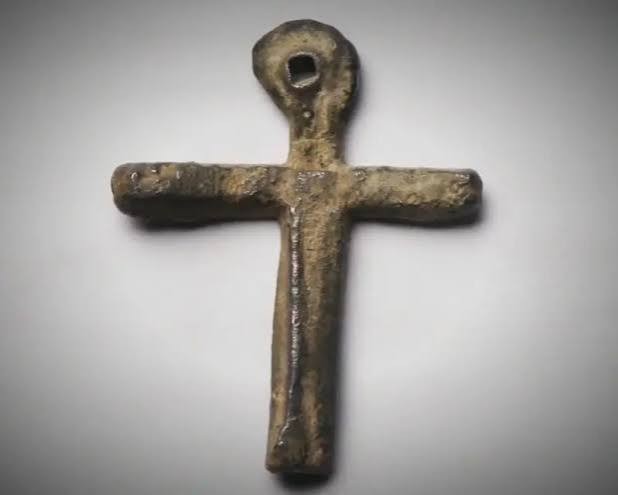
Found by metal detectorist Gary Drayton. Isotopic analyses carried out in the laboratory show that the lead comes from a European mine (possibly in France) and goes back to a pre-15th-century period. It is the number one argument that scientifically supports the Knights Templar lead.
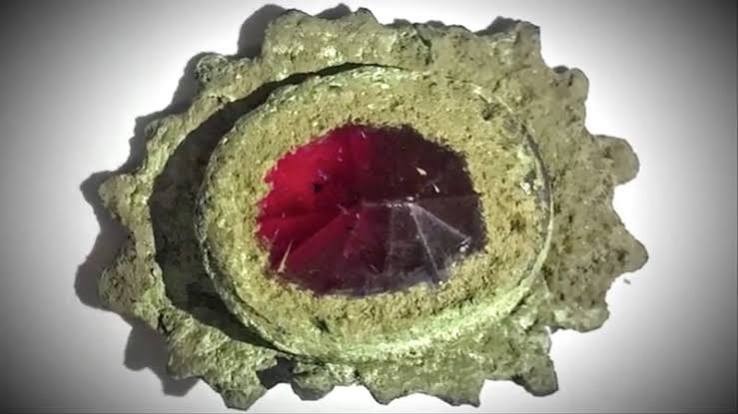
A splendid old brooch set with an authentic raspberry-red stone (a rhodolite garnet). Gemological examinations reveal a pre-modern hand cut and a silver-alloy setting dated between the 16th and 17th centuries, suggesting jewellery of the high nobility or valuable loot.
On the famous parcel 5, the last one bought by the Laginas, the team recovered from the soil exceptional fragments of old glazed terracotta pottery of Spanish origin, as well as a very rare medieval metal seal matrix used by the high aristocracy to seal official documents. These objects indicate an ancient human presence; their “elite” status remains an interpretation.
Analysed with an X-ray fluorescence (XRF) spectrometer by scientist Emma Culligan, this very old fragment of lead taken from parcel 5 bears enigmatic engravings. The analyses indicate an ancient lead of European type; the link with the Templars is not established.
2. ANCIENT COINS AND MILITARY BUTTONS
The soil, the secondary parcels and the swamp of the island have yielded many coins of various origins and infantry buttons:
A copper coin found buried deep under the stone-paved road of the swamp, typical of the era when the galleons of the Spanish Empire carried the riches of the New World.
Dug up on the famous parcel 5 (Lot 5) that the Lagina brothers managed to buy last. It is to date one of the oldest European coins ever found in North America.
The team uncovered several military uniform buttons, notably some belonging to the famous 63rd Regiment of Foot of the British army. Examined closely in the laboratory, they certify the passage and stationing of detachments of English soldiers during the American War of Independence.
A Roman bronze coin of Emperor Claudius II (AD 268-270) as well as dozens of colonial coins spanning the 17th to the 19th century, including a very rare solid-copper British penny dated 1797, testifying to the endless passage of sailors and settlers.
3. ORGANIC CLUES AND HUMAN REMAINS
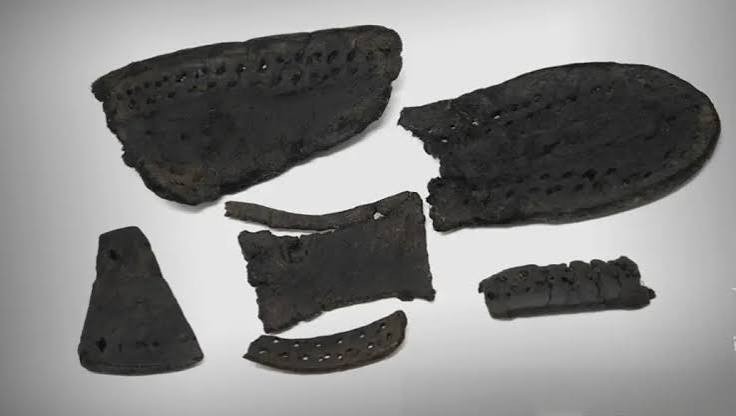
A leather heel and sole were brought up from the spoil of borehole 8-B, near the Money Pit (season 8, 2020). Radiocarbon dating places them between 1492 and 1662, at 95% confidence, therefore before the 1795 discovery. Other shoe fragments were found in the swamp (season 13); their dating is preliminary and must be confirmed. That these objects belonged to men present during the original works is an interpretation, not a laboratory result.
Fragments of parchment and leather were brought up from deep boreholes, at about 45 metres deep according to the show (this depth is not confirmed by an independent source). An electron microscope analysis reportedly revealed tiny traces of ancient ink pigments. Some see in this a clue to hidden documents; this result has not been published or independently confirmed.
Two fragments of human bone were brought up from borehole H8, near the Money Pit, at about 49 metres (160 feet) deep, according to reports on the show. A DNA analysis, presented by researcher Timothy Frasier (Saint Mary's University), points to two individuals: one belongs to a very common European maternal group (haplogroup H), the other to a group associated with the Middle East (haplogroup T). The researcher made clear that the resolution was limited: these attributions remain provisional and say neither when these people lived nor what their possible role on the island was.
4. THE LATEST DISCOVERIES (NOVEMBER 2025 – MAY 2026)
25 episodes aired on History between 4 November 2025 and 5 May 2026. The team looks for the “solution channel”, a suposed cavity under the Money Pit (at about 230 feet, around 70 m), then concentrates its efforts on Lot 8, Lot 5, the swamp road and the “Peacock” area. To date, no treasure has been found.
Five telescoping caissons were driven in; none reached the planned depth without complications, and none yielded a treasure. Water sampling picked up silver, gold, copper and zinc in the area, especially near the “Baby Blob”. Wood samples from shaft 2A (2024) gave the island's highest silver content and its third highest gold content. According to the show's team, no shaft of the channel yielded physical proof of a treasure.
A stone block of about 18 tonnes was lifted by crane. Underneath appears a stone “cradle” bound by three materials. A trench met shale at about 1.8 m deep, which suggests an earlier excavation. Chain links and an English lead seal were also found there.
Human-made stone structures. According to a specialist site, a stone circle about 13 feet (3.9 m) across, with notches about 4 feet apart, sits over a rectangular stone foundation of about 30 × 45 feet, revealed by a magnetometer survey in season 11. There is also a second circle 6 feet across, a standing stone, an annex and a reopened stone well. Digging began in 2023, directed by archaeologist Laird Niven.
Interpretations. The 13-foot diameter matches that of the original Money Pit shaft: this is an observation, not a proven link. The show dates the circular structure to 1236 from an archaeoastronomical analysis, an indirect estimate that assumes the alignments are intentional (see “to be verified” below).
Owner of lot 5 until his death. According to a specialist site relying on his own account, he had bought this four-acre plot from Fred Nolan: agreement in summer 1995, transfer in June 1996. He reportedly found a coin in 1996 that he believed was Norse, then collected 67 numbered objects by hand between 1998 and 2008 under a provincial licence, leaving the land unploughed and uncleared. Around the year 2000 he reportedly showed a stone structure to archaeologist Laird Niven, who recalled it on screen in April 2023. Rick and Marty Lagina announced the purchase of the lot in January 2023. These details rest on a single source; the price is not known.
Karma-1 reaches 212 feet deep and, when the spoil is sorted, yields a hand-forged rosehead nail (an old type of nail). The “Top Pocket Find” shaft gives only 17th- and 18th-century objects of no value.
Two individuals (17th-18th centuries) were found at about 49 m (162 feet) deep. Their identity remains unknown.
The filming of this period ends in a 15th-century church linked to the Order of Christ.
These datings come from the show's team. They are interesting, but they are interpretations, not independently validated proof.
- Mortar and structure of Lot 8: possibly 13th century; chain about 500 years old, lead seal about 700 years old.
- Radiocarbon dating and dendrochronology: part of the activity in the 13th-14th centuries, another in the 17th-18th.
- Portuguese coin (tornês) dated to 1371 at the latest by a numismatist.
- Lead isotopes: a bar from Smith's Cove would be linked to a mine in the south of France, closed around 1300.
- Nolan's Cross dated to about 1200 by an archaeoastronomical analysis (Adriano Gaspani), published in a scientific paper according to a specialist site; the date assumes the alignments are intentional, and the Templar attribution remains an interpretation.
- Gold-copper alloy: pre-Columbian or colonial origin still debated.
- The decipherments linked to Francis Bacon are not independently validated.
- The suposed Smith's Cove “flood tunnel” has never been found as a continuous passage.
- Fred Nolan saw the swamp as a human-made work; Spooner's analysis judges it relatively recent.
- 1. The Comeback (4 Nov 2025) : The Laginas and the team relaunch their search for the treasure.
- 2. Billion Dollar Baby (11 Nov 2025) : The team makes an ancient discovery on Lot 5.
- 3. Medieval Intentions (18 Nov 2025) : New discoveries lead to a revelation that could change history.
- 4. The Smoking Gun (25 Nov 2025) : A find in the swamp could have explosive consequences.
- 5. Keep On Rockin' (2 Dec 2025) : The team discovers another human-made structure on Lot 5.
- 6. The Heat Is On (9 Dec 2025) : The team finds a clue that could lead it to the answers it is looking for.
- 7. Walk the Line (16 Dec 2025) : The team makes new spectacular discoveries.
- 8. Into the Fold (23 Dec 2025) : A discovery with possible religious implications.
- 9. So Close, Yet Sonar (30 Dec 2025) : The team drills through a surprising discovery, deep in the Money Pit area.
- 10. Boulder and Wiser (6 Jan 2026) : On Lot 8, an artefact that could date back to medieval times.
- 11. A Knight's Journey (13 Jan 2026) : New clues could reveal who is behind the Oak Island mystery.
- 12. A Fort Knight (20 Jan 2026) : The team investigates a Knight of Malta who might have visited Oak Island.
- 13. Testing Their Metal (27 Jan 2026) : The team discovers a surprising vein of silver in the Money Pit.
- 14. The Shining (3 Feb 2026) : Hints of a second Money Pit.
- 15. Swamped (24 Feb 2026) : Surprising events around the dig site in the Money Pit area.
- 16. Raising the Stakes (3 Mar 2026) : The team prepares to lift the enormous boulder on Lot 8.
- 17. The Missing Links (10 Mar 2026) : The team redoubles its efforts, with exciting results.
- 18. Breaking the Seal (17 Mar 2026) : A structure that could hide a shaft or a tunnel.
- 19. Axis of Medieval (24 Mar 2026) : Exciting discoveries on Lot 8 and in the Money Pit area.
- 20. The Sands of Time (31 Mar 2026) : A shocking revelation on Lot 8.
- 21. A Sacred Symbol (7 Apr 2026) : A find brings new elements on a possible link with the Templars.
- 22. Road Trip (14 Apr 2026) : New revelations about the sand-and-stone road crossing the swamp.
- 23. Island Hopping (21 Apr 2026) : Marty contributes to a very interesting discovery on Lot 8.
- 24. Overseeing the Dig (28 Apr 2026) : The team launches a large-scale dig in the Money Pit area.
- 25. Pure Gold (5 May 2026) : The team makes a stunning revelation on Lot 8.
5. CLUES OF ENGINEERING AND TOOLING
Found in 1804 at 27 metres deep in the original shaft by the Onslow Company. This 90 kg slab of green granite carried encrypted symbols translated in 1866: “Forty feet below, two million pounds are buried”. Used sacrilegiously as an anvil by a leather binder in Halifax, it mysteriously disappeared in the 1910s.
Here is the exact historical reproduction of the original symbols that were engraved on the hidden face of the rock before it wore away:
Dozens of galleon nails and giant coconut-fibre filters imported from the Caribbean. The expert blacksmith Carmen Legge examines these objects closely to date the steel precisely and identify their colonial or medieval forging method.
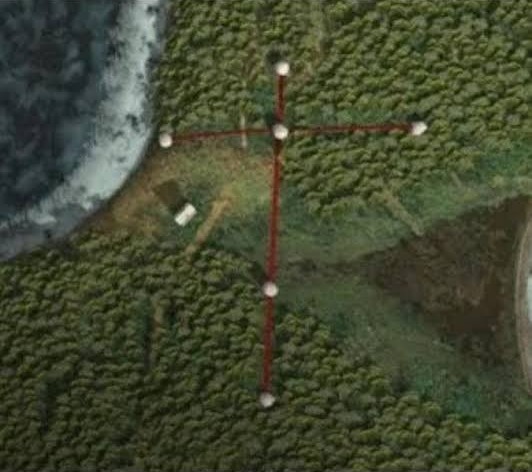
A formation of stone blocks in the shape of a cross, discovered by surveyor Fred Nolan on his land, in 1981 according to several sources (one source says the 1970s instead). It has six elements: five conical granite boulders, named A to E, each about 8 × 9 feet (2.4 × 2.7 m), and a sandstone block shaped like a human head, the “Headstone”, where the arms meet. According to a specialist site, the formation spans lots 5 and 21, with a roughly north-south vertical axis (single source).
Interpretations, not verified. According to Nolan, the stones are laid out geometrically, pointing to the North and the Money Pit. Researchers read symbolic measurements into it (144, 432, 720, 864 feet…) and alignments with the solstices or the Cygnus constellation, but their figures do not agree with one another. An archaeoastronomical analysis (Adriano Gaspani) would date it to about 1200, assuming the alignments are intentional; a more precise date (1217) circulates, for which we have not found the source. It is not known whether the formation is natural or human-made.
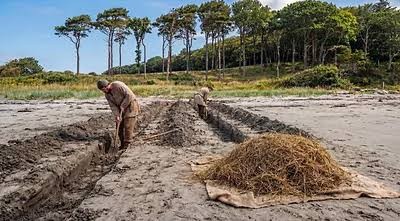
Uncovered in season 8 (episode “The Boys Are Back”, 2020) by archaeologists David McGinnis, a descendant of Daniel McGinnis, and Aaron Taylor, this craft kiln indicates activity on the island before the 1795 discovery. Pine tar was used mainly to caulk ship hulls, but also to waterproof tunnels. The large quantity of charcoal found indicates repeated burnings; archaeologist Laird Niven even suggested that the glow of this kiln could have drawn the attention of the young discoverers of 1795. A competing theory, defended by author Joy Steele, goes further and argues that the Money Pit itself is only the remains of a tar kiln of the South Sea Company, a hypothesis that has never won general agreement.
Last review: October 2026 · Unofficial site · Legal notice · The Blog