🌐 ENGLISH VERSION
This site was written in French, and this is its English translation. Small differences or imperfections are possible: the French version remains the reference. The reader comments area and the search results may still appear in French.
Your opinion matters: tell me what you would change or add. Use the contact form on the home page or leave a comment on the Blog (English and French both welcome).
SMITH'S COVE
“The remains of a secret harbour and the hydraulic traps of the Atlantic.”
THE COFFERDAM WORKSITE
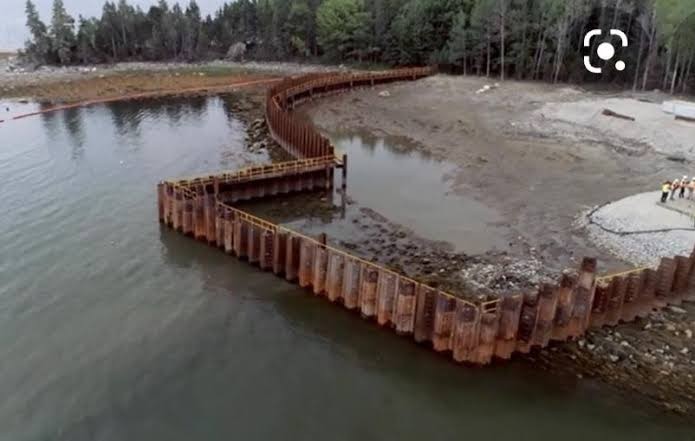
Smith's Cove is the most important and strategic coastal area of the island. This is where the drain system that many consider to be the origin of the Money Pit's flooding is located. To inspect this beach, constantly drowned by Atlantic tides, the Lagina brothers staged a truly monumental engineering challenge.
They had a huge temporary steel cofferdam built, a metal wall driven straight into the middle of the ocean. By holding back the waves and running powerful pumps, they managed to dry the beach out completely. This colossal project allowed the excavators to scrape the ground dry, revealing secrets buried under the sand for centuries.
THE U-SHAPED STRUCTURE & THE CROSS
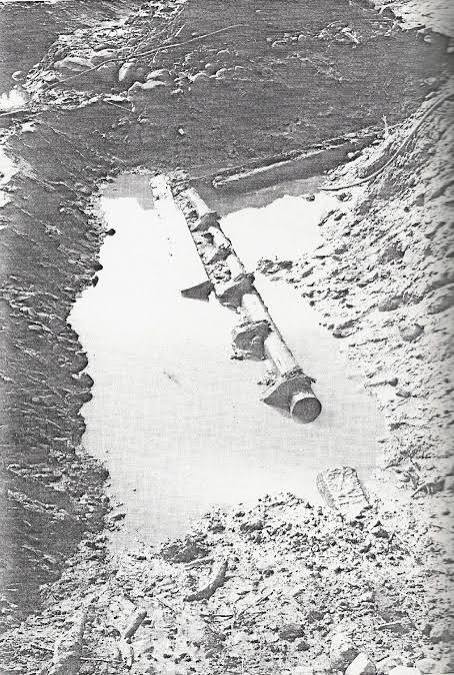
Once the ocean was pushed back behind the cofferdam, the beach yielded exceptional archaeological remains. Archaeologists uncovered the mythical U-shaped Structure, a monument of massive timber of incredible span, locked together by large wooden pegs and carved with mysterious Roman numerals.
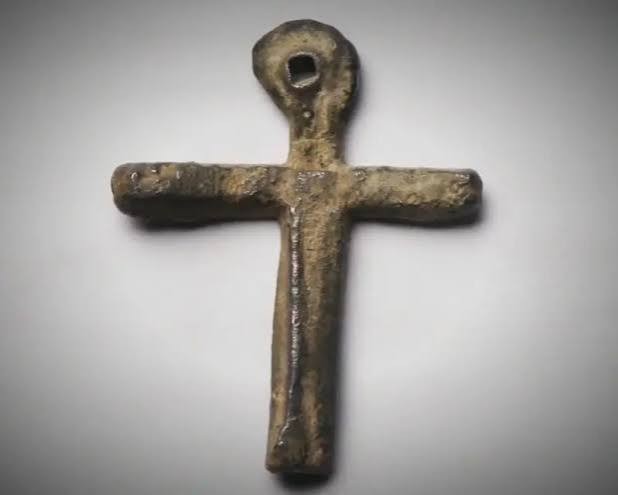
Laboratory analyses officially dated this structure to the 1760s, which indicates that major work was carried out here before the official 1795 discovery. It was also on this dried-out beach that metal detectorist Gary Drayton recovered the famous medieval lead cross, which the show dates to the 14th century. It is often presented as the main clue of the Templar trail, the idea that the Order fleeing Europe left a treasure on the island, but this interpretation is unproven and remains debated.
THE FAN-SHAPED DRAIN SYSTEM AND THE SUNKEN WHARF
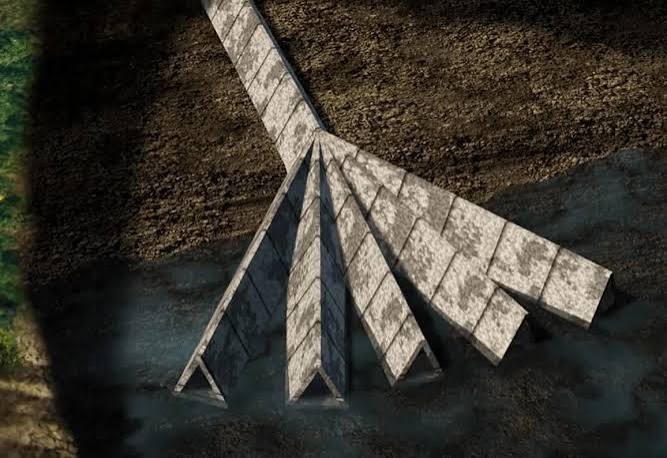
The big cofferdam made it possible to uncover a remarkable technical system. This coast was entirely excavated to install a set of drains: five stone drains built in the shape of fingers of a hand, called the fan drains. They were covered with tonnes of coconut fibre imported from the Caribbean and with lines of rock to act as a giant filter. Hypothesis: according to the most widespread interpretation, these channels would have carried sea water at each rising tide towards underground tunnels, in order to flood the Money Pit shafts. Nobody has been able to prove this from end to end.
Another, more down-to-earth hypothesis: Wikipedia mentions the possibility that these drains are the remains of a salt works. The author Dennis King (2010) argues they were used to concentrate sea water to produce salt for preserving fish, probably in the 18th century, which would explain the lack of documents (avoiding the salt tax). King himself acknowledges weak points, such as the rain or the uncertain use of the U-shaped structure. He also reports that Dunfield found in the mid-1960s a well about 25 feet deep linked to this system, with no flood tunnel. This is a hypothesis, not proof.
What was found in 1850. According to Oak Island Tours, it was the Truro Company that uncovered the system. Removing the sand and gravel from the beach, the workers reached a brown layer of fibres resembling coconut husk, identical to that of the Money Pit borings: 2 to 3 inches (5 to 8 cm) thick, it spread over about 145 feet (44 m) of shoreline, from the low-water line to the high-water line. Beneath it lay 4 to 5 inches (10 to 13 cm) of decayed eel grass, then a compact mass of beach rocks with no sand or gravel. To remove these stones, the workers built a wooden cofferdam around this stretch and found that the clay which originally formed the beach had been removed and replaced with beach rocks. An unusually high tide overtopped the dam, which was not designed to withstand pressure from the inside; rebuilding was judged too costly and the shoreline work was abandoned. At the bottom of the excavation lay five carefully built drains: parallel lines of stones about 8 inches (20 cm) apart, covered with flat stones, starting wide apart and converging towards a common centre.
A flood tunnel nobody has seen. The idea that a tunnel links these drains to the Money Pit, at about 110 feet (34 m) deep, is a nineteenth-century assumption drawn from the flooding observed: according to criticalenquiry.org, nobody has reported seeing it. In 1850 the Truro Company dug an auxiliary shaft to 109 feet (33 m) and then a lateral tunnel from 110 feet: water burst in. In 1864 workers believed they had found the tunnel at about 110 feet (about 1.2 m high by 0.8 m wide); blocking it did not stop the inflow. As for the tests: in 1965 Dunfield found no dye link with the neighbouring sea, and his camera showed no tunnel in a 140-foot (43 m) shaft; in 1995 the Woods Hole dye test detected none along the shoreline (see the Money Pit page). These earlier tests detected no open tunnel, which does not prove there never was one; the 2019 test, presented below, gives a different result.
A dye test in 2019. In the episode “Dye Harder” (Season 6, aired March 2019), the team pours a red dye into borehole C-1, at the Money Pit, hoping it would cross the supposed flood tunnel of Smith's Cove; a green dye had already been used in Season 2. Three drones and a boat crew watch the shoreline. Gary Drayton then spots a rust-coloured or orange liquid trickling from under a rock in the cove (Marty Lagina notes it is “rust rather than red”; Drayton suggests the ground it passed through may explain the difference). Jack Begley and Paul Troutman then compare the sample with fresh red dye using a fluorometer: the readings are comparable. According to the recaps, the water in the Money Pit shafts therefore communicates with the cove through an underground channel, but nobody knows whether it is natural or built. Another source says that in 1988 Dan Blankenship ran a test in 10-X whose dye reportedly came out in the cove and on the north and south shores: this contradicts the 1995 Woods Hole test, which detected nothing, and we have only one source for 1988.
Open questions (the author's reflection, not facts). If these drains brought seawater towards the pit, why did the dye come out only in the cove, and not more widely? Why were the five drains not cleared and followed, beyond their point of convergence, along the coast? Why was the dye test not repeated in several holes, with several tracers and at several tides? Here are some leads, not yet verified: (1) run the test the other way round, pouring the dye into the drains on a rising tide and watching the Money Pit wells; (2) compare the water level in the wells with the tide; (3) measure salinity at several depths; (4) scan the ground of the dried-out beach (ground-penetrating radar or resistivity); (5) dig at the point where the five drains meet. These are ideas, not results: we hope one day to find an answer.
Right next to this trap, the excavators cleared an ancient massive wharf or unloading quay, completely hidden under marine sediments, which suggests that very large boats may have moored here well before 1795. The analysis of these timbers and the enormous forge nails was entrusted to the elite blacksmith Carmen Legge. His expertise confirmed a method of assembly and an early colonial dating. This quay may have been used to land heavy equipment; this is a hypothesis, not an established fact.
See also: for the exact dates of the U-shaped structure timber (felled in 1769) and the other samples, see the page “Dating & Analyses”.
Last review: October 2026 · Unofficial site · Legal notice · The Blog