🌐 ENGLISH VERSION
This site was written in French, and this is its English translation. Small differences or imperfections are possible: the French version remains the reference. The reader comments area and the search results may still appear in French.
Your opinion matters: tell me what you would change or add. Use the contact form on the home page or leave a comment on the Blog (English and French both welcome).
THE TREASURE THEORIES
“From buccaneers to state secrets: the riddles surrounding Oak Island.”
1. THE PIRATE LEAD AND CAPTAIN KIDD
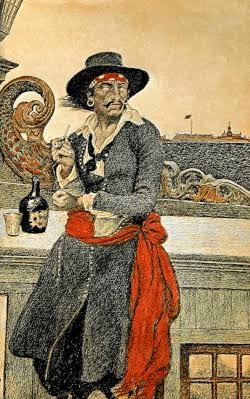
The very first historical theory born on the island, in 1795. According to the legend, the famous Scottish pirate William Kidd buried a huge part of his war booty on a desert island in the Atlantic. The three young boys who discovered the tackle block in the old oak were convinced they were digging up Kidd's lair. The island would have served as a common vault for several crews of buccaneers, which would explain the old Spanish coins found in the ground.
An observation on the tackle block: the 1893 prospectus, summarized by the Eastern Chronicle of 5 April 1894, describes a large oak with marks on its trunk and a sawed-off branch overhanging the depression, but does not mention a tackle block. A handwritten note in the Public Archives of Nova Scotia points this out ("no mention of tackle block on tree"). It is not proof that the tackle block never existed: only that this first printed text does not mention it.
Born in Dundee, Scotland, he became a ship's captain and settled in New York. A privateer during the war between England and France, he was sent against pirates in the Indian Ocean in 1696. In 1698 he seized the rich Quedah Merchant; the law having changed, he was treated as a pirate, arrested in Boston in 1699, tried in London and hanged on 23 May 1701 (the first rope broke). The only documented treasure is a small cache left on Gardiners Island, recovered and sent to England as evidence. The sources we consulted report no statement from him about hidden treasure, and the legend of his buried loot grew up after his death.
A more recent theory moves the trail from pirates to wreck hunters. The documented fact: in 1687, William Phips's crew found the wreck of the Spanish galleon Nuestra Señora de la Pura y Limpia Concepción, sunk in 1641 on the Silver Bank in the Caribbean, and recovered several dozen tonnes of silver from it (one source gives 34 tons of silver, gold and jewels combined; estimates vary).
Born on the Maine frontier, first a shepherd, then a ship's carpenter and sailor. Knighted in 1687 by James II after the Concepción wreck, he led the 1690 capture of Port Royal in Acadia, then became in 1692 the first royal governor of Massachusetts. He died in London in 1695, aged 44.
Hypothesis, unproven. Graham Harris and Les MacPhie argue that Phips secretly kept part of the treasure to help finance the Glorious Revolution of 1688, then hid it on Oak Island; they rely on a period, from June 1688 to January 1689, when he disappears from the records. The authors admit they have no incontestable proof, no document shows he ever came to Oak Island, and this silence can be read as a simple gap in the archives. A specialist source also notes that this date is much earlier than the usual timeline of the legend.
A family of theories sees the Money Pit as the cache of a treasure from the Americas. According to one of them, a 16th-century Spanish galleon, damaged by a storm, called at the island and its crew buried the gold intending to return: this is Dan Blankenship's belief, according to History UK. A variant, presented on a specialist site, points to an Inca treasure, tied to Pizarro's conquest and the execution of the emperor Atahualpa on 26 July 1533.
Hypothesis, unproven. None of these sources gives proof. Coconut fibres are sometimes cited as a sign of South American origin, but this link is not demonstrated, and nothing explains how a treasure would have travelled so far from its starting point. No document ties a specific galleon to Oak Island.
2. THE MILITARY & ARISTOCRATIC LEAD
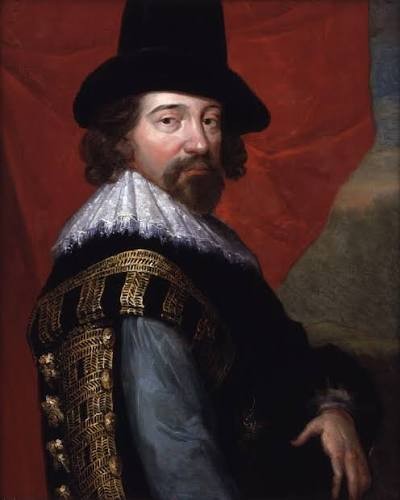
One of the most fascinating surface theses of the show, which fits surgically with the deep finds of the Money Pit. First put forward in 1953 by the American Penn Leary in his book The Oak Island Enigma (self-published), this hypothesis claims that the English philosopher, scientist and statesman Sir Francis Bacon — secret head of the mystical brotherhood of the Rosicrucians — was the true hidden author of the plays of William Shakespeare. Bacon would have orchestrated a secret transatlantic voyage to shelter the priceless original manuscripts and revolutionary philosophical parchments. To protect them from decay, the documents would have been locked in sealed boxes with large quantities of liquid mercury, then sunk into a masonry vault surrounded by a protective cement of extreme hardness. This hypothesis offers a possible explanation for the discovery by the early companies of fragments of an old glass mercury vial and pieces of cement under the rock at more than 45 metres deep [💡].
An American lawyer based in Omaha, Nebraska, he wrote The Oak Island Enigma, self-published in 1953: the earliest known version of the thesis linking Oak Island to Francis Bacon. He later published several books on alleged Bacon ciphers hidden in Shakespeare's work (1987, 1990, 1993). His book appears in Oak Island bibliographies; the sources we consulted show no evidence that the thesis rests on any document or find.
English philosopher, lawyer and statesman, Lord Chancellor from 1618 to 1621 under James I. His essays remain famous, and he called for new ways of studying nature.
Launched by Delia Bacon (no relation) and William Henry Smith, it was very popular in the 19th and early 20th centuries. Today almost all Shakespeare scholars reject it: in 1957 the cryptographers William and Elizebeth Friedman concluded that the “hidden codes” claimed in the works were not valid. The link with Oak Island, proposed by Penn Leary in 1953, remains a hypothesis.
He argues that a cipher hidden in Shakespeare's First Folio (1623) leads to Oak Island, where manuscripts by Francis Bacon would lie in the Money Pit. Facts attested by a specialist site: he carried out digs on the island in 2003, with the help of Dan Blankenship, and the documentary The Seven Steps to Mercy (2017) presents his ideas. His reading of the cipher is rejected by Shakespeare scholars and has never been independently verified.

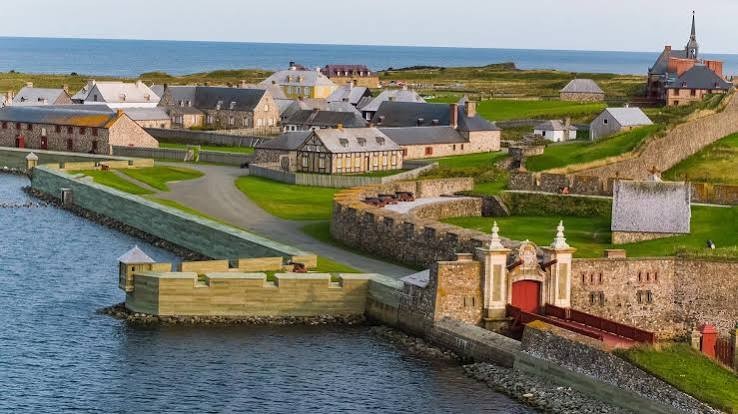
An extremely solid thesis studied closely by Rick Lagina and Doug Crowell. During the British sieges of 1745 and 1758 against Louisbourg (the largest French bastion in North America), the military engineers and the French royal Treasury would have received secret orders to evacuate the troops' pay and the riches of the fortress. Absolute masters of naval engineering and hydraulics, these elite soldiers had all the skills required to design a complex network of artificial flood tunnels and hide the royal treasure on Oak Island, at a perfect distance for a safe retreat.
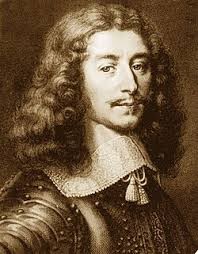
This theory links the mystery to the prestigious French aristocratic line of La Rochefoucauld, and notably to the gigantic naval military expedition led by the Duke d'Anville in 1746. Historically, the house of La Rochefoucauld takes its name from the majestic fortified castle of the Charente built as early as the 11th century by the lord Foucauld on a steep, defensive rocky base overlooking the valley. According to supporters of this theory, documents and plans discovered in France would link certain members of this family to the protection of state secrets; we have not been able to verify them. Its supporters see a link with Freemasonry; no alignment on the island has been independently verified.
The largest French force sent to the New World before the American Revolution: about 64 ships and 11,000 men, which left Île d'Aix on 22 June 1746 to retake Louisbourg and Nova Scotia. Storms, typhus and scurvy ravaged the fleet. At Chebucto (present-day Halifax) the Duke died on 27 September 1746; the expedition was a complete failure. It is cited in the La Rochefoucauld theory; to our knowledge, no link with Oak Island has been established.
A French stronghold on Île Royale (today Cape Breton Island, Nova Scotia), founded in 1713; the fortified town was built from 1719. Taken by New England forces in June 1745, returned to France in 1748 by the Treaty of Aix-la-Chapelle, it was retaken by the British in July 1758, then dismantled from 1760. Partly rebuilt by Canada from 1961, it is today a national historic site.
A tragically romantic hypothesis that draws on real facts. During the French Revolution, just before her failed escape attempt, Queen Marie Antoinette would have entrusted her most precious jewels and diamonds to her most faithful lady-in-waiting. Backed by officers of the royal navy, the latter would have fled to England before crossing the ocean to shelter the treasure of the monarchy at the bottom of the Money Pit. This would explain the discovery at very great depth of fragments of inked parchment, of old leather and of the famous rhodolite garnet brooch of Lot 8.
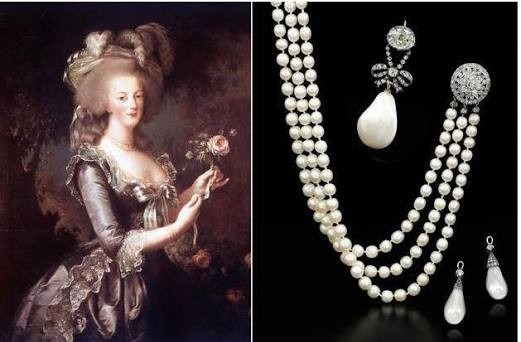
An Austrian archduchess born in Vienna, married in 1770 to the future Louis XVI, and Queen of France from 1774 to 1792. After the royal family's escape attempt, stopped at Varennes on 21 June 1791, she was imprisoned, tried in October 1793 and guillotined on 16 October. The sources we consulted mention no shipment of her jewels to England or America; the Oak Island hypothesis rests, so far, on no document.
A French painter, born and died in Paris, portraitist of Queen Marie Antoinette, of whom she painted about thirty portraits. She left France in 1789, at the start of the Revolution, and lived abroad for about twelve years (Italy, Austria, Russia). She appears here only because her painting illustrates this section: she has no connection with Oak Island.
OTHER HYPOTHESES: LEADS WITHOUT PROOF
These leads are hypotheses: we report them because they circulate, not because they are proven. They are presented with their criticisms.
See also: ground that collapsed on its own, or a shaft dug by men? The page “Natural or Dug?” presents both readings and what remains unexplained.
In 1762, British forces captured Havana, in Cuba, along with large sums of money. This hypothesis, defended notably by William Crooker according to Wikipedia, assumes that part of this loot was hidden on Oak Island to keep it from American revolutionaries. Critics note that no direct trace of British military or government activity has been found on the island.
Signs carved on a stone from the Money Pit are said to have resembled the Coptic alphabet, hence the idea that Egyptian Coptic Christians dug the shaft. This thesis, associated with Barry Fell, is not accepted by academics. The text of the stone itself is known only through old accounts: this lead remains a simple conjecture.
Jerald (Jerry) Harrah, an independent researcher in California, argues that Oak Island held not a treasure but a discreet French naval repair and logistics base, active in the days of French Acadia, between about 1680 and 1714 (the dates vary across the author's own pages). According to him, the island formed a “nine-part system”: a timber wharf, a shipyard, tar production, and so on. The Money Pit would be a tidal pressure shaft linked to the sea by oak drains, and the island would have been called “Isle du Chesne”. He relies on manuscript maps he attributes to Franquelin (1686) and Pierre Puget (1684), on a 1689 map and on Colbert's naval policy; the Rochefort arsenal serves him as a general model. This theory is not validated: his papers are openly deposited on Zenodo, which is not peer review, the author himself calls for tests (excavation, hydrogeology, maritime history), and we found no document in the Rochefort archives that mentions Oak Island. The wells and drains it describes do, however, recall the Smith's Cove drains, which explains its appeal to enthusiasts.
His more recent publications (February-March 2026). Three Zenodo deposits refine the theory. A map titled “Oak Island: A Nine-Piece Puzzle” (10 February) presents the nine features described above. A paper on the “Forest Slipways” (12 February) describes two side-by-side slipways running from the shore inland to a U-shaped deck about 6 m (20 feet) from the water, in the middle of the forest, where a capstan would have hauled boats up; the author sees a discreet base for 6 to 10 men. A third (14 March) proposes reading the Money Pit as a “tidal hydraulic system”: tidal pressure and a freshwater lens under the island would push water into a timber-lined shaft, while a red-oak channel of about 800 m (half a mile) between Smith's Cove and the swamp would act as a “natural hydraulic ram”; he sees in it the explanation for the collapses, the flooding and the stone pad of about 53 × 30 m (175 × 100 feet). None of this is demonstrated: the deposit pages we could read cite no archives, excavation reports or dated sources for these claims, and we have not read the full texts. These are personal interpretations, not peer-reviewed.
Worth noting: the wood of Smith's Cove's U-shaped structure was dated by dendrochronology to 1769 (Colin Laroque), which does not match the 1680-1714 period put forward by Harrah. Details on the page “Dating & Analyses” To read the author himself: author's website.
Mahone Bay has about 365 islands, according to some sources. Two small islands near Oak Island come up from time to time among enthusiasts. Frog Island lies northeast of Oak Island: a geological study by Gordon Fader and Robert Courtney considers that a shoal on that side is likely a submerged continuation of Frog Island. According to a post on the blog “Oak Island Treasure”, a group led by Peter Beamish camped there in 1965 with the owner's permission, and Daniel J. Sullivan later dug there in 1976, 1977, 1978, 1979 and 1983. He describes a pit, stopped at about 27 ft (8 m) because of water seepage, and man-made objects down to about 25 ft (7.6 m); he concludes that many men lodged there while the Money Pit was being built. These are his claims: we found no independent report confirming them. Apple Island lies, according to the website The Curse of Oak Island, about half a mile (800 m) east of Oak Island. The same site says that in 1994 Dan Blankenship founded the Mahone Bay Exploration Company to explore Frog Island and Apple Island, without notable results. In season 6 of the TV show (episode “As Above, So Below”), Jack Begley, Gary Drayton and diver Tony Sampson go there, at coordinates taken from Travis Taylor's “star map”, which overlays the constellation Taurus on the region. They find three large boulders, whose arrangement looks deliberate to them, and Gary Drayton's metal detector picks up several targets, including a non-ferrous one. None of this is proven: no excavation has taken place, no archaeological analysis has been published, and the boulders could also be a natural glacial deposit. These islands are private property.
An old map gives a dated landmark: on A. F. Church's map of Lunenburg County (copyrighted in 1864, published in 1883 according to a map-selling site), Oak Island bears the label “Kidd's Treasures”, and Frog Island appears with no owner's name. Source: David Rumsey Map Collection.
Speculation, separate from the facts above: what could these islands have been used for by whoever worked on Oak Island? Suggestions include a lookout to watch for incoming boats, a base to lodge men and store equipment during the work, or a hiding place for a ship. Nothing proves any of this. And since the bay holds hundreds of islands, the proximity of two of them proves nothing in itself.
3. THE SACRED LEAD: THE KNIGHTS TEMPLAR AND THE AZORES
The Knights Templar (or Order of the Temple) were an order of warrior monks born in the Holy Land in 1119 and suppressed in 1312: their history, with that of their main figures, is told on the page The Knights Templar: the context. The legend was born of their sudden fall, on Friday 13 October 1307: part of the Templar fleet based at La Rochelle is said to have escaped in the night with the secret treasure of the Temple. The historians we consulted report no evidence of this escape. According to tradition, the surviving knights allied with the line of Henry Sinclair and sailed across the North Atlantic centuries before Christopher Columbus; but the only account of that voyage dates from 1558, and no evidence of it has been found.
A Scottish nobleman, Earl of Orkney from 1379. The only account of a voyage to North America attributed to him is a 1558 publication credited to Nicolò Zeno the Younger, which does not name him: the identification dates from 1784. In 1898 the historian F. W. Lucas showed there is no evidence that Sinclair ever crossed the Atlantic. His role in the Templar legend and on Oak Island is therefore a matter of tradition.
In Season 11, the episode “May the Norse Be With You” explores the idea that Vikings teamed up with the Knights Templar to reach the island. We found no evidence of this partnership: it is a lead raised on the show, nothing more. What is known is that Norse people did reach North America, but far from Oak Island, in Newfoundland.
A small village at the northern tip of Newfoundland where Norwegian explorer Helge Ingstad and his wife, archaeologist Anne Stine Ingstad, found the remains of a Norse camp in 1960; it was excavated from 1961 to 1968. A tree-ring study dates the felling of the wood to 1021. According to the sources we consulted, it is the only authenticated Norse site in North America; it has been a UNESCO World Heritage Site since 1978. No such site has been authenticated at Oak Island or in Nova Scotia.
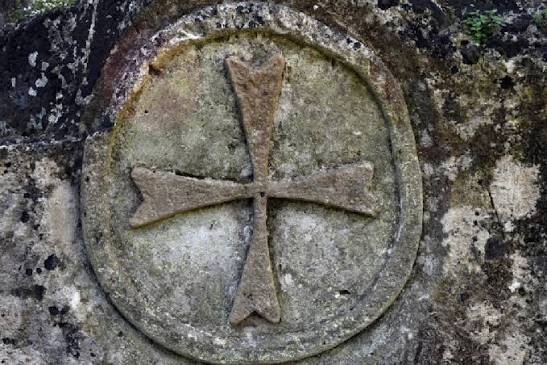
During a crucial scientific investigation trip led by Rick Lagina to the Azores islands, in Portugal, the team found wells which, for supporters of the Templar thesis, would be a possible link. Inspecting the old lands controlled by the Order of Christ (the official successors of the Templars in Portugal), archaeologists examined deep medieval stone wells, hand-built in masonry, which resemble, by their circular architecture and rock assembly, the famous Lot 26 well of Oak Island. For supporters of the Templar thesis, these Portuguese constructions of the 11th and 12th centuries suggest the same know-how; this is not proof that medieval navigators crossed the ocean.
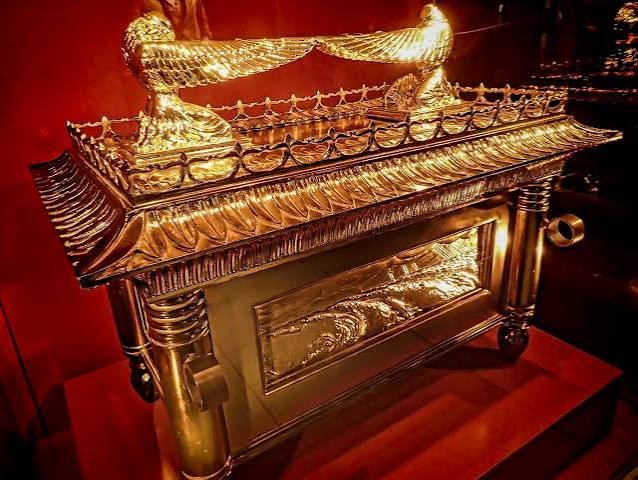
The Templar lead leads to an even more dizzying hypothesis. In Season 3 (“Columbus Day”), researcher Jeff Irving puts forward that the Ark of the Covenant — the biblical chest said to contain the Tablets of the Law handed to Moses — was smuggled out of Jerusalem by the Templars, then entrusted to Christopher Columbus, himself linked to the Order, to be put in safety on Oak Island. Later in the series, the Freemason Scott Clarke in turn brings a map on which a symbol engraved in Templar churches would point directly to the island, and which he says is associated with the Holy Grail. No artefact found to date supports either of these leads — they rest entirely on the broader Templar hypothesis, without independent proof.
A navigator born around 1451 in the Republic of Genoa, who died in Valladolid, Spain. In Spanish service he made four transatlantic voyages between 1492 and 1504; on the first he reached an island in the Bahamas on 12 October 1492. The sources we consulted mention no link between Columbus and the Templars or Oak Island: that link is a hypothesis put forward on the show.
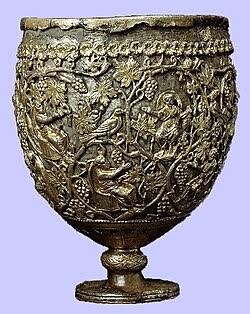
What do we know about these sacred objects? Setting speculation aside, here is what the sources say about the fate of the Ark of the Covenant, the Grail and the Menorah. Only the Ark and the Grail were raised on the show (see above); we found no documented link between the Menorah and Oak Island.
A gold-covered acacia-wood chest, described in Exodus, that held the tablets of the Law. Placed in the Tabernacle and then in Solomon's Temple, it is last mentioned in the Book of Chronicles, when King Josiah orders it returned to the Temple. Its fate is unknown: Jewish tradition holds that it vanished when the Babylonians took Jerusalem in 586 BCE. Hypotheses include its being carried off to Babylon, hidden in a cave by the prophet Jeremiah (Second Book of Maccabees), or kept at Axum in Ethiopia, as the Ethiopian Orthodox Church claims. The idea that the Templars took it to France is described by the sources we consulted as highly speculative.
The word “grail” originally meant a serving dish. It first appears in Perceval, the Story of the Grail, an unfinished romance by Chrétien de Troyes written around 1180–1191: a dish carrying a single wafer, which the author never explains. Shortly afterwards Robert de Boron (Joseph of Arimathea) made it the cup of the Last Supper, said to have caught the blood of Christ. It is thus an object of medieval literature; no historical evidence links the Templars to a Grail quest, a link proposed as a symbol in 1818 by Joseph von Hammer-Purgstall.
A seven-branched gold lampstand, described in the Bible in the Tabernacle and then in the Jerusalem Temple. After the Romans destroyed the Second Temple in 70 CE it was taken to Rome: Josephus reports it was paraded in the triumph of Vespasian and Titus, and the Arch of Titus shows soldiers carrying it. It was still in Rome when the Vandals sacked the city in 455. Its later fate is unknown: several historians think it was taken to Carthage and recaptured by the Byzantines in 533; no record confirms that it ever returned to Jerusalem, and it is not known whether it was destroyed, melted down or lost.

Historian and spiritual confidante of Rick Lagina, the sparkling Zena Halpern shook up the research by bringing the famous “Cremona Map”, dated 1347. Presented as written in Old French, this map, annotated with landmarks such as “The Well” or “Smith's Cove”, is presented as having guided the team to the beach drains, but its authenticity is disputed. When she died in 2018, Zena bequeathed all her boxes of notes and secret maps to Rick, who said he wanted to continue this research. Since 2023, the Italian researcher Emiliano Sacchetti has been taking up this work, notably around the Cremona document.
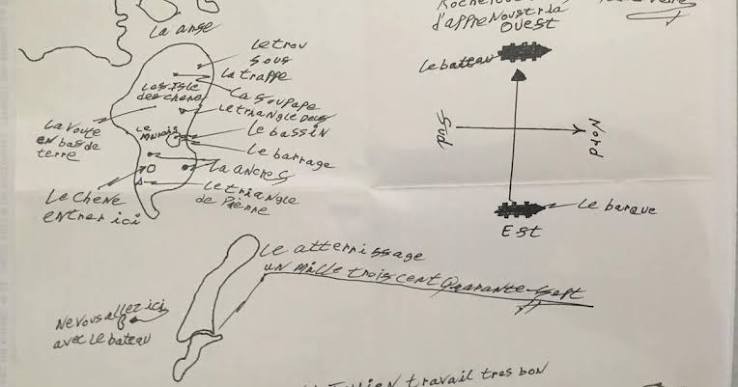
The Cremona document: what we know, and what is disputed
Where it comes from (according to Zena Halpern). Doug Crowell put her in touch with the team in November 2016, and she presented her documents in season 4 (episode 1), during a conference call with Marty Lagina, Craig Tester and Doug Crowell. She traces them back to a certain W. David Jackson, who allegedly bought a “Templar document” in 1971 from a certain Mr Benvenuto, in Cremona, Italy.
What it shows. A map annotated in French, dated 1347, showing a basin, a swamp, a dyke, “la chêne” (the entrance), anchors, a valve and “Le Trou Sous la Trappe” (the hole under the trapdoor). To this are added a second map, dated 1179, which mentions Nova Scotia, and a page of symbols called “The Formula”, a substitution cipher of which the cryptologist Kevin Knight (University of Southern California) proposed a partial reading.
What is disputed. According to critics, no trace of the seller in Cremona has been found, and the whole chain of ownership rests on Jackson, whose existence could not be independently verified. Archaeologist Andre Costopoulos points out faulty French (articles, accents) and handwriting with modern forms; he concludes that, if an original exists, the document shown is a very recent copy. According to a critical website, Don Ruh, co-owner of the documents with Halpern, even declared them fake in 2018.
Our position. The document's authenticity is not established and the critical analyses we have found point to a recent origin. We present it as a lead told by the show, not as proof.
Last review: October 2026 · Unofficial site · Legal notice (FR) · The Blog